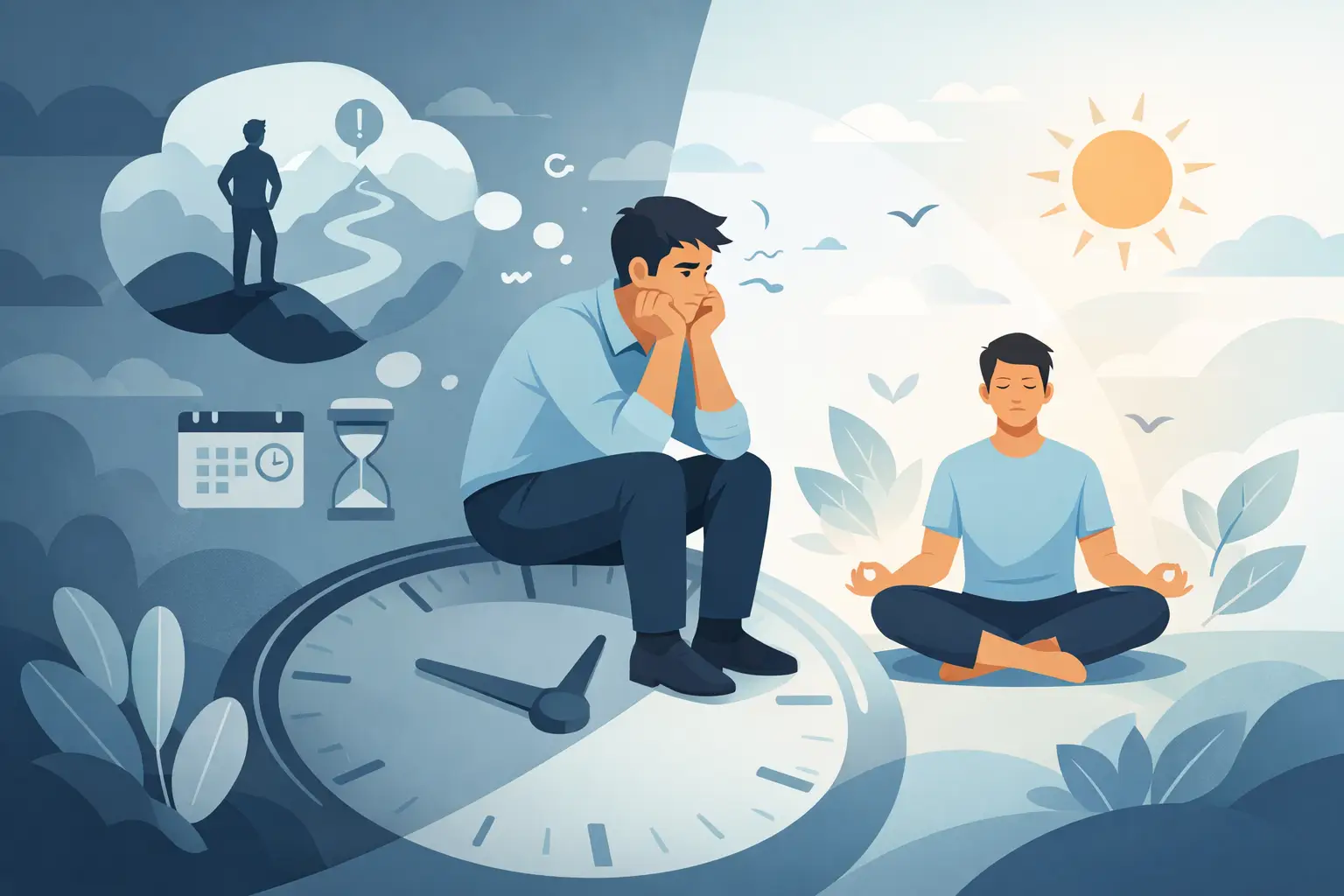
A habit rarely begins as a conscious decision. It may be the cigarette on the walk to the station, the glass of wine after a difficult call, checking your phone before you are fully awake, or putting off a task until anxiety makes it harder to start. The best methods for habit change take this seriously. They do not rely on telling yourself to be more disciplined when you are already tired, stressed or overwhelmed.
For many people, the habit is not the real problem. It is a learned response that has become linked to a feeling, situation or time of day. Change becomes more manageable when you understand what the behaviour is doing for you, then develop another way to meet that need.
Why willpower is rarely enough
Willpower has a place, particularly at the beginning of a change. But it is unreliable when a habit is tied to stress, lack of sleep, loneliness, pressure at work or a particular environment. A busy professional may decide every morning not to snack at their desk, only to find themselves doing exactly that after a demanding afternoon. This is not a moral failure. It is a pattern being repeated in familiar conditions.
When clients visit our practice, they could be feeling frustrated that they know what they should do but cannot seem to follow through. They may have read the books, tried an app, made rules for themselves or used sheer determination for a few weeks. The old habit then returns during a difficult period, which can make them feel as though nothing has worked.
A more useful starting point is curiosity. Rather than asking, “Why can’t I stop?”, ask: “What tends to happen just before this?” Notice the place, time, thoughts, physical sensations and emotions around the behaviour. The answer is often more specific than people expect.
The best methods for habit change begin with the pattern
Identify the cue, routine and reward
Most recurring habits follow a simple loop. Something prompts the behaviour, the behaviour offers a short-term payoff, and the brain learns to repeat it. The cue might be a notification, an argument, the end of the working day, boredom on the train or the feeling of being criticised. The reward may be relief, distraction, comfort, stimulation or a temporary sense of control.
Writing this down for a week can be surprisingly revealing. You do not need an elaborate journal. A brief note about what happened before and after the habit is enough. If you want to stop smoking, for example, it may become clear that certain cigarettes are strongly connected to transitions: leaving the house, finishing a meal or stepping away from work. Those moments need a plan in their own right.
In our practice, we often see clients who… have spent years trying to change the visible behaviour without addressing the anxiety, belief or emotional pressure underneath it. Once the wider pattern is understood, the work becomes more precise.
Make the desired action smaller than your resistance
A common mistake is setting a target that demands a complete reinvention of daily life. Someone who has not exercised for months may commit to an hour at the gym six days a week. Someone struggling with sleep may decide they must follow a perfect evening routine immediately. These intentions are understandable, but they can create an all-or-nothing standard.
Start with an action that is easy to complete even on an ordinary, demanding day. Put on your walking shoes and go outside for five minutes. Read one page rather than setting a rule to read for an hour. Prepare tomorrow’s lunch while the kettle boils. The point is not that five minutes solves everything. It is that repetition builds evidence: this is something I do now.
Small actions work best when they are attached to something already established. After making your morning tea, take your medication. When you close your laptop, write the first task for tomorrow. After brushing your teeth, practise two minutes of slow breathing. The existing habit becomes a reliable prompt for the new one.
Change the environment before testing your resolve
Your surroundings often decide more than your intentions. If biscuits are visible on the kitchen counter, if social media is one tap away during work, or if alcohol is the easiest way to mark the end of the day, the old route remains convenient. Making a behaviour slightly less automatic can create the pause needed to choose differently.
This does not have to mean removing every temptation or controlling your life rigidly. It may mean keeping your phone outside the bedroom, not buying cigarettes “just in case”, preparing food before you become very hungry, or putting running clothes by the door. For habits you want to build, reduce friction. For habits you want to reduce, add it.
The trade-off is that environmental changes can feel inconvenient at first. That is often exactly why they help. A habit survives because it is efficient. A little practical inconvenience interrupts the automatic sequence.
Work with the thought behind the behaviour
Some habits are strengthened by thoughts that sound factual but are really old assumptions: “I need this to calm down”, “I always mess this up”, “If I do not check my messages, something will go wrong”, or “I deserve a drink after the day I have had.” Trying to argue aggressively with yourself rarely helps. It is more useful to examine whether the thought is completely true, and whether acting on it moves you towards or away from what matters to you.
All people are different, but we see some who may be highly capable at work while quietly relying on habits that help them manage pressure in the short term. This can include overeating, avoidance, scrolling, nail biting, drinking, smoking or pushing through exhaustion. The behaviour may have begun as a coping strategy, so removing it without building another source of regulation can leave a difficult gap.
A replacement needs to be realistic. If the reward is a moment of decompression, a suitable alternative might be a brief walk, a shower, a relaxation practice, music, a call with someone supportive or simply sitting without a screen for ten minutes. It does not need to be virtuous. It needs to be available when the urge arrives.
Plan for difficult moments, not ideal days
Habit plans often fail because they are designed for a calm Monday morning rather than a late night, an argument, a delayed train or a week of poor sleep. Think ahead about the situations in which the old behaviour is most likely. Decide what your first response will be, and make it specific.
For example: if you feel the urge to smoke after lunch, walk around the block before deciding. If you are about to order food because you feel depleted after work, eat the meal already prepared or have a filling snack first. If you want to avoid an important task, work on it for ten minutes before checking anything else. A plan does not remove choice, but it makes the healthier choice easier to find under pressure.
Lapses are also part of the plan. One cigarette, missed workout or evening of overeating does not erase previous progress. The more helpful question is what happened around the lapse, and what you need next. Shame tends to feed the very patterns people are trying to change. A calm reset is more effective than punishment.
When tailored therapeutic support can help
Self-directed strategies can be very effective for straightforward habits, especially where the triggers are clear and the change feels manageable. But it can be harder when a pattern is long-standing, emotionally charged or linked to anxiety, insomnia, low mood, trauma, pain or a sense of losing control. In these circumstances, focusing only on behaviour can feel like trying to manage the leaves while ignoring the roots.
Cognitive hypnotherapy can help explore the associations and automatic responses that keep a habit in place. Used alongside practical behavioural work, it may support people to respond differently to familiar triggers and strengthen a more helpful internal pattern. Depending on the person and the issue, approaches such as NLP, EFT or relaxation-based techniques may also be considered. The emphasis should always be on an individual plan, not a standard script.
This is particularly relevant for smoking, compulsive habits, emotional eating, sleep-related routines and avoidance driven by fear. Therapy is not about handing control to someone else. It is about understanding your own responses better and practising tools that can be used between sessions, in the situations where change actually needs to happen.
Measure progress in a way that keeps you going
Do not only measure success by a perfect streak. Notice whether urges are shorter, whether you recover faster after a lapse, whether you pause before acting, or whether a trigger has less power than it did a month ago. These are meaningful signs that a habit is becoming less automatic.
Choose one pattern to work on first, make the next step modest and observe it without judgement for a fortnight. Lasting change is usually less dramatic than people expect. It is built through repeated moments in which you respond to yourself with a little more awareness and a little more choice.
If you’re based in London and would like to explore this further, you can get in touch with us.