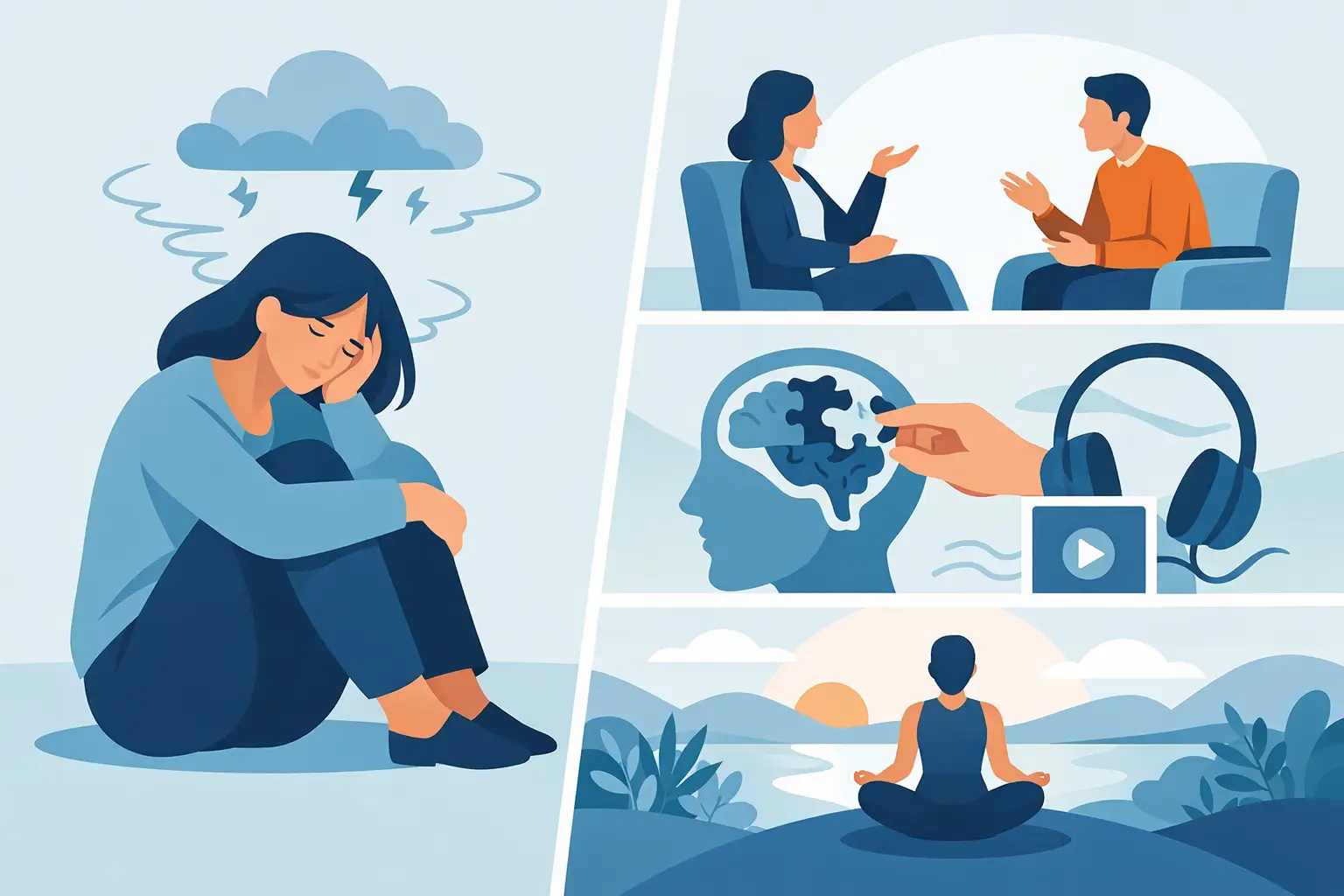
A cough that lingers for a few days, a pulse that feels a little faster than usual, or an unfamiliar sensation after a long day can quickly become the centre of your attention. A guide to managing health anxiety begins with recognising that the distress is real, even when the feared illness is unlikely. You are not being dramatic or weak. Your mind is trying to protect you, but it may have become stuck in a pattern of scanning for danger.
For many busy people, health anxiety sits alongside an otherwise capable life. You may keep up at work, look after others and appear calm, while privately searching symptoms late at night, checking a mole repeatedly, or waiting for reassurance to wear off before the worry returns. The aim is not to ignore your health. It is to respond to it in a proportionate, steadier way.
What health anxiety can look like
Health anxiety is a persistent fear that a bodily sensation, change or test result signals a serious condition. It can affect people who are physically well, those managing a genuine health condition, and people who have previously experienced illness in themselves or someone close to them.
When clients visit our practice, they could be feeling exhausted by the amount of mental space health worries take up. Some have attended medical appointments and received reassurance, but cannot settle afterwards. Others avoid appointments because they fear bad news. Both responses can keep the anxiety going.
The pattern often follows a familiar sequence. You notice a sensation, interpret it as dangerous, feel anxious, then check, search online, ask someone for reassurance or monitor the symptom more closely. There may be a brief sense of relief. Unfortunately, the relief teaches the brain that checking was necessary, making the next trigger feel even more urgent.
Why reassurance does not always reassure
Reassurance is not inherently wrong. Medical advice matters when there is a new, severe or concerning symptom, and it is sensible to follow guidance from a GP or other qualified clinician. The difficulty comes when reassurance becomes a repeated attempt to remove every trace of uncertainty.
No one can be given a guarantee about their health. Health anxiety asks for precisely that certainty, then treats the absence of it as evidence of danger. A normal test can become “perhaps it missed something”. A doctor’s calm explanation can become “they did not understand how serious this feels”.
In our practice, we often see clients who have become highly skilled at noticing small changes in their bodies. They may know exactly how a symptom felt at 9am compared with 2pm. This level of monitoring can make ordinary sensations feel louder and more alarming. Stress itself can produce physical effects, including tension, digestive discomfort, headaches, dizziness, disrupted sleep and a racing heart. Recognising this does not mean assuming every symptom is anxiety. It means allowing anxiety to be one possible explanation rather than immediately choosing the worst one.
A guide to managing health anxiety day by day
The first useful step is to name the cycle as it happens. Rather than saying, “Something is seriously wrong”, try, “I have noticed a sensation, and my health-anxiety alarm has gone off.” This creates a little space between the feeling in your body and the story your mind is building around it.
Next, pause before acting on the urge to check. You do not have to stop all checking at once. In fact, trying to do that abruptly can feel overwhelming. Start by delaying it for ten minutes, then twenty. During that time, bring your attention to something outside your body: the sounds in the room, the feel of your feet on the floor, or a task that needs your full attention. The goal is not to force anxiety away, but to show yourself that an anxious thought can be present without dictating your next action.
It can help to set sensible boundaries around internet searches. Searching symptoms is tempting because it offers the feeling of doing something. Yet search results cannot assess your individual context and tend to place serious explanations alongside common, harmless ones. If you decide to look for information, use one reliable source, set a time limit and avoid repeated searches for the same concern.
You may also benefit from writing down the feared prediction and a more balanced alternative. For example: “This headache means there is something seriously wrong” can become “Headaches have many causes, including poor sleep, stress and dehydration. If it persists or changes significantly, I can seek appropriate medical advice.” The balanced thought is not blind reassurance. It is a realistic response that leaves room for uncertainty.
Make a clear plan for medical concerns
A practical medical plan can reduce the constant internal debate about whether to seek help. Consider discussing recurring worries with your GP, particularly if you are unsure what signs should prompt an appointment. Together, you may be able to clarify when monitoring is appropriate and when further reassurance is unlikely to help.
If you develop severe, sudden or worsening symptoms, or have been advised to seek urgent medical attention for particular signs, follow medical guidance promptly. Managing health anxiety should never mean dismissing a genuine concern. The balance is learning not to treat every ordinary sensation as an emergency.
All people are different, but we see some who may be caught between frequent appointments and complete avoidance. Neither is a moral failing. They are understandable efforts to feel safe. Therapy can help you develop a middle ground: taking responsible action where needed, while reducing the rituals that keep fear at the forefront.
Look at what makes the alarm louder
Health anxiety is rarely only about a symptom. It often intensifies during periods of pressure, poor sleep, grief, uncertainty or burnout. A demanding role, a difficult relationship, a change in your body, or caring for an unwell relative can leave your nervous system on high alert.
Notice the context around difficult days. Does the checking increase after poor sleep? Does it appear when you are alone in the evening, or after reading difficult news? Understanding these patterns is useful because it shifts the focus from “What is wrong with me?” to “What is my mind trying to manage right now?”
Simple regulation techniques can help lower the physical intensity of the alarm. Slow breathing, with a longer exhale than inhale, may settle the body enough for clearer thinking. A short walk without monitoring your sensations, regular meals and a more consistent bedtime can also make anxiety less reactive. These are not cures in themselves, and there will be days when they make little difference. They are supportive habits that give your system fewer reasons to stay on edge.
When tailored support may help
If health worries are shaping your choices, disrupting sleep, affecting work or straining relationships, it may be worth speaking to a therapist. Support is particularly useful when you understand the pattern logically but still feel unable to interrupt it in the moment.
At City of London Hypnotherapy, work is tailored to the individual rather than based on a standard script. Cognitive hypnotherapy may be used alongside practical approaches to identify the triggers, beliefs and habitual responses maintaining the fear. For some people, the focus is reducing compulsive checking. For others, it is working with a fear rooted in a previous illness, a bereavement or a strong need to stay in control.
Hypnotherapy is not about being made to ignore your body or accept a false sense of certainty. Used responsibly, it can support calmer attention, emotional regulation and different responses to intrusive thoughts. The most useful therapeutic work gives you tools you can apply between sessions, particularly when an anxious urge arrives at an inconvenient moment – on the Tube, before a presentation, or in bed at night.
Progress is usually measured less by never having another health-related thought and more by what happens next. You might notice a sensation and decide not to search it. You might book an appropriate appointment without spending the preceding week in panic. You might tolerate uncertainty for longer and return your attention to the life in front of you. Those changes can be quiet, but they matter.
“If you’re based in London and would like to explore this further, you can get in touch with us.”