You feel a sensation in your chest, your stomach drops, and within seconds your mind has leapt to the worst possible conclusion. Then comes the checking – symptoms online, your pulse, the mirror, the question to someone close to you: does this look normal? Health anxiety hypnosis is often something people look into when reassurance stops working, but the fear keeps returning.
Health anxiety can be exhausting because it does not stay neatly in the background. It can interrupt work, sleep, travel, relationships and even ordinary quiet moments. Many people with health anxiety are thoughtful, capable and used to coping well in other parts of life. That is often why the problem feels so frustrating. On paper, they know the fear may be out of proportion. In the body, though, it feels completely real.
What health anxiety actually feels like
Health anxiety is not simply being concerned about your wellbeing. Most people pay attention when something changes physically. The difficulty begins when normal sensations, minor symptoms or vague discomfort quickly become linked with danger. A headache becomes something serious. Tiredness becomes evidence that something is wrong. A harmless bodily sensation gets scanned, analysed and monitored until it feels larger and more alarming.
When clients visit our practice, they could be feeling embarrassed by how much time they spend checking, searching or asking for reassurance. They may also feel frightened by how convincing their thoughts seem. Some have had repeated medical tests and still do not feel settled. Others avoid appointments because they are afraid of what might be found. Both patterns can be part of the same anxiety cycle.
All people are different, but we see some who may be constantly monitoring their body, and others who only spiral when stress is already high. For some, the fear centres on one illness. For others, it shifts from one concern to another. The common thread is not a lack of intelligence. It is a nervous system that has become highly alert to threat.
How health anxiety hypnosis may help
Hypnotherapy is not about persuading you that symptoms should be ignored. A responsible therapist will always take genuine health concerns seriously. The aim is different. It is to reduce the pattern of fear, hypervigilance and catastrophic thinking that turns uncertainty into panic.
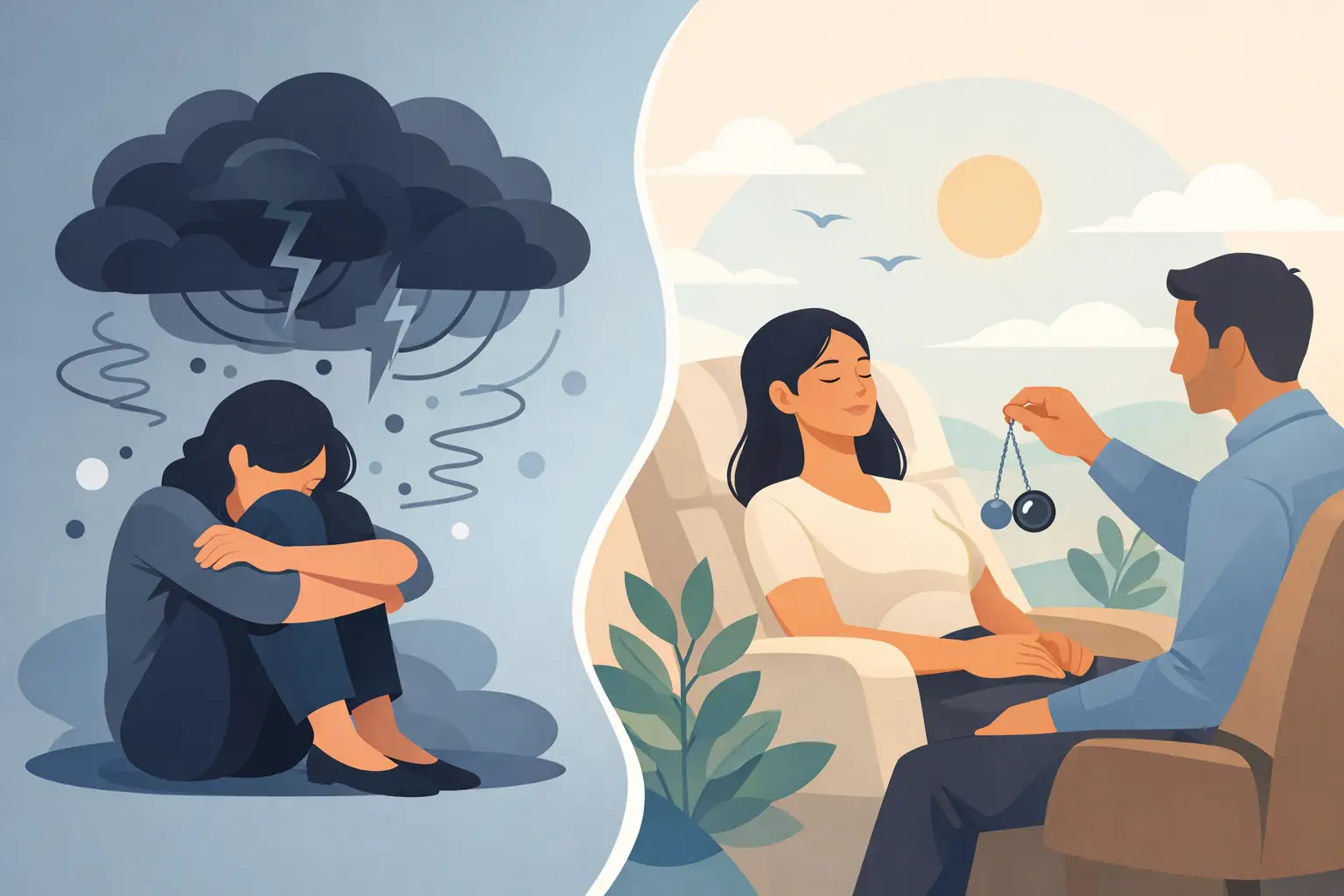
In simple terms, hypnosis is a focused state of attention. In that state, people are often more able to step back from automatic reactions and respond differently. If your mind has learned to scan for danger, react quickly and seek certainty at all costs, hypnotherapy can help interrupt that loop.
Health anxiety hypnosis is often most useful when it is part of a wider therapeutic approach rather than treated as a one-off relaxation exercise. Relaxation can help, but on its own it may not be enough. If the deeper pattern remains untouched, the mind often goes straight back to checking and fearing.
At City of London Hypnotherapy, the work is usually more tailored than a generic script. That may include cognitive hypnotherapy, elements of NLP, practical anxiety tools and ways to change how the mind responds to uncertainty. The goal is not to force positive thinking. It is to help the brain stop treating every sensation as an emergency.
Why reassurance rarely fixes the problem
One of the hardest parts of health anxiety is that reassurance can feel helpful for a short while. You check a symptom, ask a partner, book a test, or hear from a doctor that things look fine. You settle briefly. Then another thought appears: what if they missed something? What if this is different? What if it is early?
That is why the issue is not always the symptom itself. Often, it is the relationship with uncertainty. The anxious mind keeps demanding absolute certainty, but real life does not provide that. So the person checks more, thinks more, and notices more. Unfortunately, that usually trains the brain to stay on alert.
In our practice, we often see clients who have become very good at scanning for signs of danger without realising it. They can tell you exactly how often they check, what they fear, and what the latest trigger was. What they have often lost is a sense of ease in their own body.
Hypnotherapy can help create enough internal calm for that pattern to soften. It can also help people notice the moment anxiety starts building, before they are fully pulled into it. That matters because health anxiety often moves quickly. A small sensation becomes a frightening interpretation, and then the body responds with genuine stress symptoms, which seem to confirm the fear.
What happens in therapy
A good first step is understanding your specific pattern. There is no single profile. One client may be terrified of heart symptoms after a stressful period. Another may fear neurological illness and spend hours searching online. Another may worry after a real past health scare and feel unable to trust their body again.
Therapy usually starts by identifying how the cycle works for you. What triggers the fear? What do you do next? What temporary relief do you get? What keeps the pattern going? Once that becomes clearer, treatment can be more precise.
Hypnosis itself is usually calm and structured. You remain aware and in control. Many clients describe it as feeling deeply absorbed or mentally quieter than usual. In that state, therapeutic work can be directed towards reducing alarm responses, building tolerance of uncertainty, and changing old associations between body sensations and catastrophe.
There is also often practical work outside trance. That might include recognising checking behaviours, reducing reassurance-seeking gradually, and learning how to respond differently when fear rises. For some people, this combination is where progress becomes more solid. They are not just feeling calmer in a session. They are learning a different pattern in daily life.
Health anxiety hypnosis is not a magic fix
It is worth saying this plainly. Hypnotherapy is not a magic fix, and it is not the right route for every person in every situation. If someone is in the middle of a medical investigation, the work may need to be handled carefully. If there is trauma underneath the anxiety, that may need proper attention too. Sometimes health anxiety also sits alongside panic, OCD traits, burnout or longstanding stress.
That is why tailored treatment matters. A generic recording may help some people settle in the moment, but it cannot adapt to your history, your triggers or the specific way your mind operates. The most useful work tends to be individual, thoughtful and responsive.
It also helps to have realistic expectations. Some clients notice a shift quickly, especially if the anxiety is relatively recent. Others improve more gradually, particularly if they have been living in a state of vigilance for years. Steady progress is still progress. The aim is not perfection. It is more freedom, less fear, and a more balanced relationship with your body.
When this approach tends to work best
Health anxiety hypnosis tends to be most effective when the person is ready to work with the pattern rather than keep trying to out-check it. That does not mean you need perfect motivation. Most people come in tired, sceptical or simply fed up. But it helps if part of you recognises that endless reassurance has not solved the problem.
This approach can be especially useful for people who are functioning well on the surface but privately dealing with relentless mental noise. Professionals often become skilled at keeping things together outwardly while carrying a constant stream of fear underneath. Because they are capable in other areas, they may judge themselves harshly for not being able to stop the health worry by logic alone.
That self-criticism can become part of the strain. A calmer, more therapeutic approach often works better than trying to argue with every thought. When the nervous system settles, thinking often becomes clearer too.
If you are considering hypnotherapy, it is sensible to choose someone qualified and experienced with anxiety, rather than someone offering only generic hypnosis. Health anxiety has its own logic and habits. It helps to work with a therapist who understands how those patterns form and how to shift them carefully.
There is no shame in needing help with this. Health anxiety can make life feel smaller, louder and more exhausting than it needs to be. The encouraging part is that these patterns can change. With the right support, people often become less reactive, less preoccupied and more able to trust themselves again.
If you’re based in London and would like to explore this further, you can get in touch with us.